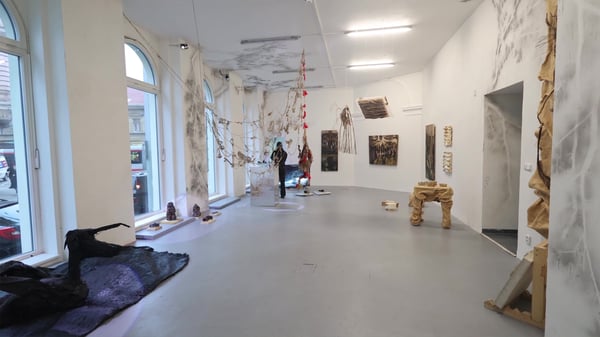
When we look at a beautiful landscape it can hurt sometimes. Maybe we are afraid that it is the last time we are able to glance at it, trying to grasp it too hard… Or perhaps we know that it is actually already not real. The exhibition transplants us into a fictional landscape. It is a strange, yet familiar place, potentially of the future. Clearly dependent on human interaction, it is a result of complex forces, pre-determined by hybrid histories.
Territories are the relationship between human cohabitation, earth systems and material processes, unfolding in time and across space. In recent history the results of large-scale exploitation linked colonialism, reterritorialisation and restructuring made the relationship and our related histories fragmented and hard to recuperate. These combined with the pressures of capitalism and the needs of industrial production created a circulation of intensities that draw the number of possible outcomes to a shrinking number. With the effects of the ongoing climate change and a sense of a looming disaster of toxic pollution, we have to think about our future in the view of past mistakes.
Take the idea of the ruin, it is something that used to belong to the past, yet increasingly it is becoming part of our future. Our epoch sets in motion reverberations and oscillations that scatter long-established boundaries and opens up a new set of divisions in time and space. Or as Rowena Harris put it in the title of her recent performance lecture: how to go forward if the future and past are not where you would normally find them.
Some people believe the Sun used to be yellow
| umělci | Rowena Harris, Ana Vaz, Elena Damiani, William Evans, Adrien Missika, Julia Crabtree |
| kurátor | Borbála Soós |
| místo | Trafó Gallery |
| tagy | |
| ůčinkující | Borbála Soós |
| kamera | Gideon Horváth R. |
| zvuk | Gideon Horváth R. |
| střih | Gideon Horváth R., Borbála Szalai |
| interview | Borbála Szalai |
| kategorie | Reportáže |
| publikováno | 27. 5. 2019 |
| jazyk | Česky / English |
| embed |  |
související s
Some people believe the Sun used to be yellow