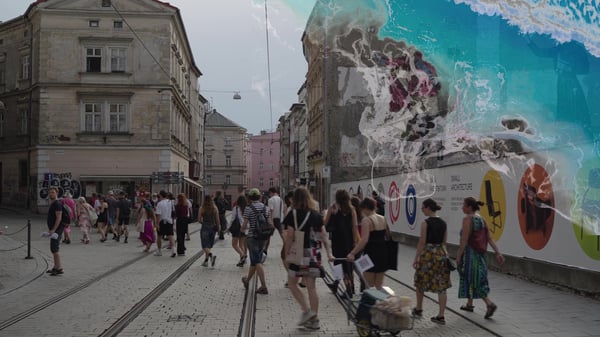

An Immersive-Curatorial-Talk on Land, Borders and Black Holes.
Global capitalism works with no borders, while the cognition of accelerated consumption knows no nationalisms.The possibility of drawing maps not delimited by the logics of nation-states and geopolitical order is a subversive and imaginative act of quantum politics. Radical ecologies insist on creating life through systems of rhizomes that go around the planet and beyond: the universe has no borders.
While hegemonic politics re-configures itself permanently, in relation to an open flow of capital, on the other hand, they affirm a border´s delimitation through neo-colonial logics, as the eternal fantasy of time. Despite all that, a sense of nomadism, interconnection and difference speak out loud against xenophobia and necropolitics, permanently disrupting the surface of land, the complexities of earth and the limits of knowledge.
The mythic and inevitable relation between day and night, light and darkness, west and non-west, is one that binds us in time. While in Mexico, one indigenous child is watching the sunset, the alarm of a business banker in Bangkok is ringing: time has no boundaries.
In this event, we will address contemporary concerns related to the imposition between limits against the deep spirit of movement, chaos, nomadism and re-territorialization, through the work of 7 artists from different parts of the globe. The event will take place simultaneously in different locations, where each artist will participate in the event, through online conversations and in situ display of their works. A collective dynamic will create an atmosphere for the incubation of dissent.
Pablo José Ramírez (1982 Guatemala) is a curator, theorist and art critic currently based in London. Ramírez has published and edited in different catalogues, magazines and books such as Artishock, Coleccion Patricia Phelps de Cisneros, Arte GT 20/21- Harvard University.
He has given talks at the CAA in New York; Temas Centrales 2, Costa Rica; ICI (Independent Curators International) New York; Parsons/New School, New York; Glasgow School of Arts, United Kingdom; Gasworks, United Kingdom, University of Montevideo, Uruguay; Arte Actual/FLACSO, Ecuador and Universidad de los Andes, Colombia. Some of his curatorial projects include: This Might Be a Place for Hummingbirds (Center For Contemporary Arts, Glasgow; UK, co-curator); The Transmodern Dictionary by Terike Haapoja (web-based); Guatemala Después, (co-curator, Parsons Gallery, New York); MUXU´X by Benvenuto Chavajay (Ciudad de la Imaginación, Guatemala); Materia Remota by Adan Vallecillo (MIN, Honduras) among others.
From 2010 to 2014 he was Executive Director and Chief Curator of Ciudad de la Imaginación in Guatemala. Ramírez was part of the jury of the 8th Inquieta Imagen contest at MADC (Museum of Contemporary Art and Design), Costa Rica, 2015, and was a member of the jury of the second edition of Contextos Volcánicos, TEOR/ética, 2015, he also was part of the Jury at Gasworks for the Latin-American Residency Program and member of the 2017 Visible Award Curatorial Advisory Board by Cittadellarte – Pistoletto Fondation and Fondazione Zegna. He was co-curator of the 19th Bienal de Arte Paiz and was resident curator of CPR (Curatorial Program Research) South American edition. He is currently conducting research in the Andean and Mesoamerican region on aspects of pre hispanic and colonial appropriations in contemporary art.